Parsing SEC EDGAR into clean profiles: a polite worker, a strict schema, and SSR pages
Owning the brief end to end as a product owner building through Claude: how far a genuinely free stack can go when you decide that trust and provenance, not features, are the product.
By Renaud Yasin
- Next.js
- Python
- Supabase
- Data pipeline
- Fintech
- Built with Claude
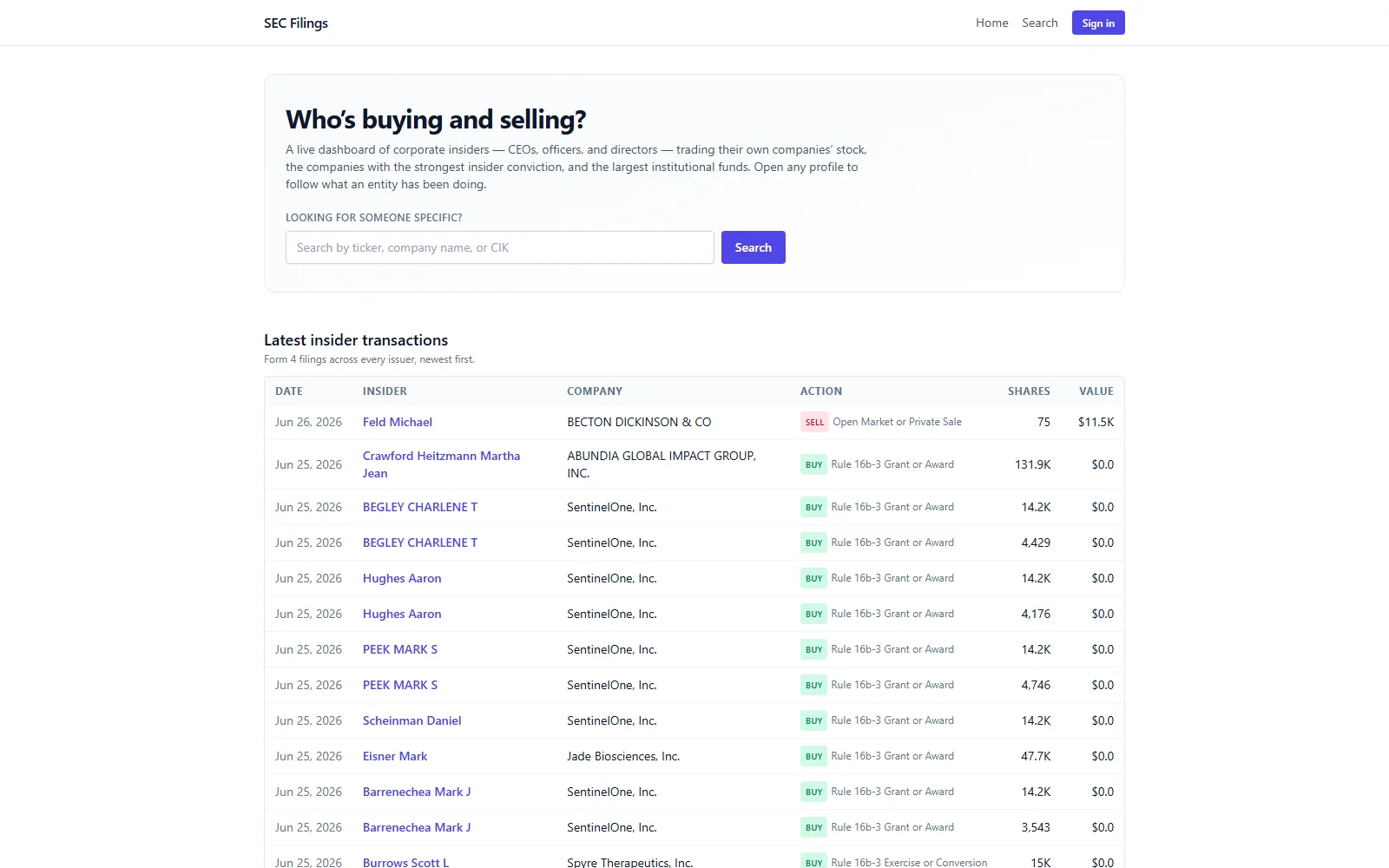
As a product owner, my job isn’t to write every line. It’s to decide what’s worth building, set the brief and the guardrails, and steer it into existence through Claude. This project was a pointed version of that question: how far can a genuinely free stack go? SEC EDGAR holds everything a retail investor or journalist could want (who’s buying their own company’s stock, what the big funds hold, what risks a company flags this year that it didn’t last), but it’s published as raw XML, inline XBRL, and HTML almost nobody reads directly. The good consumer tools cost money. The brief I set: pull the filings myself, parse them properly, and serve clean, cited profiles, all inside the Vercel Hobby and Supabase Free tiers, and find out where that ceiling actually is by building straight through it.
The brief I set
The first decision wasn’t technical. It was about who’s allowed to write data, and that single rule shaped the whole monorepo. Three tracks:
worker/: a Python 3.12 package (secf) with a Typer CLI. It discovers new filings, fetches them, parses them, runs a calculation layer, and uploads. It’s the only writer and holds the service-role key.supabase/: Postgres as the single source of truth, defined entirely by timestamped migrations, with Row-Level Security on the user-scoped tables.web/: a Next.js 15 / React 19 app that reads Supabase server-side with the anon key and renders the public profiles. No service-role key ever touches it.
Data flows one way: EDGAR → polite fetch → raw bytes archived to Storage → pure parsers → idempotent upsert → calc layer → SSR pages. I set the direction and the guardrails; Claude did the building, and the one-way contract is what let me reason about the whole thing without holding it all in my head.
Where my judgment was the load-bearing part
Being a polite guest is a product decision about whether this thing gets to exist at all. SEC bans IPs that misbehave, so an app that’s rude to EDGAR isn’t feature-poor. It’s dead. That made rate limiting a trust requirement, and exactly the kind of constraint Claude will sail past unless the brief makes it a hard line. So every outbound request carries a contact User-Agent (enforced at startup) and passes through a single global token bucket capped at 10 requests/second, shared by dependency injection, because a per-module limiter silently multiplies the real rate. Conditional GETs (ETag / Last-Modified) and backoff-with-jitter on 429/5xx round it out.
Idempotency as an invariant, not a hope. If I’m asking people to trust these numbers, re-running the worker can’t quietly change them. Filings are keyed by a UNIQUE accession number; child rows are delete-and-reinsert inside one transaction per filing. Re-ingesting any filing must yield identical row counts, and a chaos test kills the worker mid-ingest to prove no orphans survive.
Honest about the messy edges, out loud, as a feature. The temptation when AI is building is to let it paper over the ugly cases so the demo looks clean; I drew the opposite line. 13F filings give you a CUSIP, not a ticker, and there’s no free CUSIP→ticker dataset, so a missing ticker is a first-class “unresolved” state that degrades gracefully rather than a parse failure. Congressional trade amounts are disclosed as ranges, so the UI shows ranges and labels any ranking “estimated,” never a fabricated exact number.
What I’d carry forward
Two things. First, pure parsers (bytes in, dataclass out, no I/O) made the hardest code (inline XBRL, PDF transaction tables) trivially testable against golden fixtures; when Claude writes a parser whose only job is to transform bytes, I can verify it against a fixture instead of trusting it. Second, writing tests against external observables rather than the implementation’s own output: idempotency, RLS isolation, and rate limits are verified at the database or HTTP boundary, so the tests survive refactors. The lesson that stuck about my own job: when AI does the building, the product owner’s leverage is deciding what “trustworthy” has to mean and turning it into machinery the code can’t slip past. The MVP is feature-complete and runs end-to-end on a Dockerized stack today; the next steps are purely operational: deploy it and point the worker’s cron at live EDGAR.